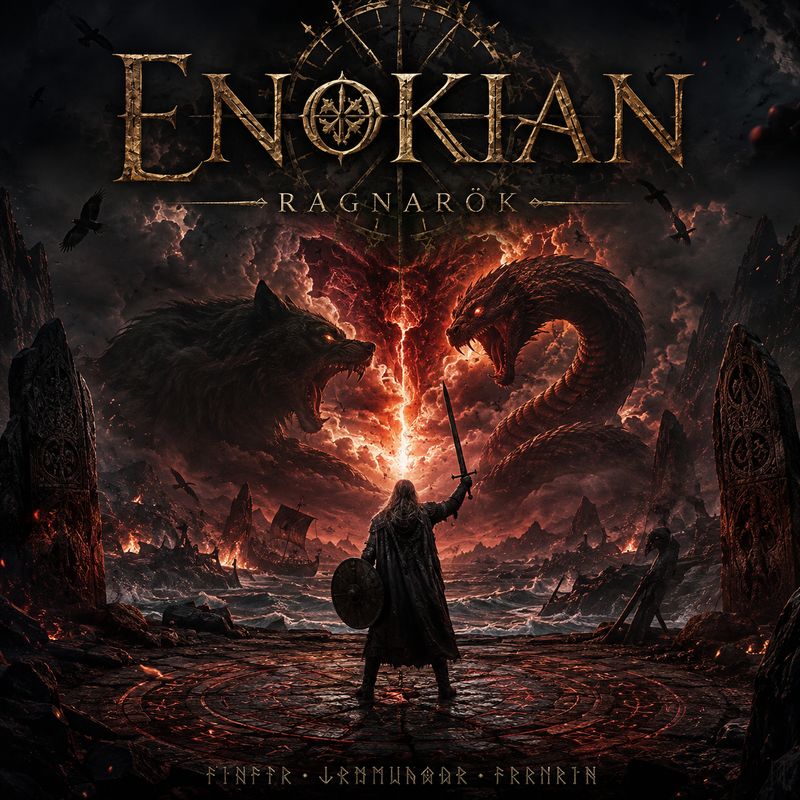
Ragnarök
Released 10 August 2026
These ten songs are drawn from texts that were written down in Iceland in the thirteenth century, from older material that had been carried by voice for a long time before that. The Poetic Edda, the Prose Edda of Snorri Sturluson. They are not the invention of this record.
What is invented is the angle. A god kneeling at a well and paying with his eye. A warrior lying in red snow who is not afraid of dying but of what he left unfinished. A goddess who says plainly that love and war were never separable. The sources give the events; the songs give someone standing inside them.
Where a passage stands behind a song, it is printed here in Old Norse with a translation beside it. Real thirteenth-century text, not a reconstruction. Where no passage stands behind a song, nothing is printed, and that is said openly rather than dressed up with a reference that does not hold.
The record ends the world and then lets it come back green. That is the shape the sources give it, and it seemed worth keeping.
The record
The record opens before the world and closes after it. Muspelheim burns while there is still nothing to burn; the last track is a goddess who has been weeping for a thousand years and says so without apology. Between the two, the order is not the order of the myth. It is the order that made sense to listen to.
Nothing here is a battle song, which was the one rule set at the start. Thor guards a wall and thinks about the houses behind it. The warrior in the snow is not afraid of dying, he is afraid of the fires he left unlit. Odin pays for knowledge and the song is about the price, not the power it bought.
The cover
A warrior stands with his back to us at the centre of a runic circle, sword raised, between the wolf on the left and the serpent on the right. He is not winning. The sky behind him has already opened and the ships are already burning.
The back is deliberate. This is not a hero to be recognised, it is a position to be taken, and the viewer is standing where he stands.
Muspelheim
The realm of fire, older than the worlds. Surtr keeps its border with a flaming sword and will one day cross it. In the Prose Edda, creation begins when the heat of Muspelheim meets the ice of Niflheim in the void of Ginnungagap: the same fire that starts everything is the fire that ends it.
Before the worlds, before the tree
Before the water, before the sea
A realm of fire, a realm of flame
Older than gods, older than name

Surtr stands guard at the border of ash
His sword of flame waits to unleash the crash
No frost can touch him, no cold can bind
The fire that ends what the fire designed

Muspelheim burns before the first day
Muspelheim waits to take it away
Fire before life, fire after all
Muspelheim answers the final call

From the sparks came the first spinning flame
Ginnungagap swallowed the void and the name
Fire met frost at the edge of the world
And from ash and ice, creation unfurled

Muspelheim burns before the first day
Muspelheim waits to take it away
Fire before life, fire after all
Muspelheim answers the final call

First flame, last flame
All things bear its name

Muspelheim burns before the first day
Muspelheim waits to take it away
Fire before life, fire after all
Muspelheim answers the final call

Before the world
After the world
The fire remains
The fire remains
Nine Worlds (Yggdrasil)
The ash that holds the nine worlds together, roots in the dark and branches above Asgard. An eagle sits at the top, the serpent Níðhöggr gnaws below, and the squirrel Ratatoskr runs between them carrying insults. Under one root lies the well of fate.
One tree stands where all worlds meet
Roots in the dark, branches in the light
Asgard above where the gods keep their seat
Below, the dead walk through endless night

Nine roads run from the one great trunk
Midgard, Jotunheim, the fire, the frost
Vanaheim's fields where the old gods sunk
Alfheim shining for what is not lost

Yggdrasil, hold the worlds in your hands
Yggdrasil, root and branch understand
Nine worlds turning on one living tree
We are the leaves of eternity

The eagle watches from the highest bough
The serpent gnaws at the roots below
Ratatoskr runs between them now
Carrying words that both must know

Yggdrasil, hold the worlds in your hands
Yggdrasil, root and branch understand
Nine worlds turning on one living tree
We are the leaves of eternity

Well of fate beneath the widest root
Norns are weaving what tomorrow holds
Every branch bends to what they compute
Every story that has yet been told

Yggdrasil, hold the worlds in your hands
Yggdrasil, root and branch understand
Nine worlds turning on one living tree
We are the leaves of eternity

One tree, nine worlds
One root, one fate
We are the branches
That the old tree makes
Odin's Eye
Odin left an eye in Mímir's well as the price of a single drink from it. The point of the story is the exchange, not the wound. Knowledge in these texts is never given; it is bought, and the buyer pays in something he cannot get back.
Beneath the roots where the water runs black
Mímir waits, and the price he demands
No gold, no gift, no crown of a king
Only the eye that has seen everything

Wisdom is not given, it is torn from the flesh
Nine worlds whisper what the blind eye sees best
I kneel at the well, I offer the price
One eye for the future, one eye for the light

One eye to see beyond the veil
One eye burns where the old gods fail
Odin's blood upon the well
All-Father walks the roads of hell

The blade finds the socket, the well drinks it in
No cry, no mercy, no place to begin
The runes rise screaming from the dark below
Now the All-Father knows what no man will know

One eye to see beyond the veil
One eye burns where the old gods fail
Odin's blood upon the well
All-Father walks the roads of hell

What is sight, when the future bleeds
What is a god, who kneels and pleads
The price of knowing is never free
I gave my eye, now the world sees me

One eye, one price, one throne
All-Father stands alone

One eye to see beyond the veil
One eye burns where the old gods fail
Odin's blood upon the well
All-Father walks the roads of hell

The well runs still
The eye remains below
All-Father sees
What no man will ever know
Thor's Wrath
Thor stands between Midgard and what lives outside it. His duel with the stone-hearted giant Hrungnir is one of the oldest episodes told about him. He is not a god of glory but of the boundary, and the songs about him are always about who is left behind the wall.
The sky turns black, the mountains shake
Mjölnir rises, the giants quake
No wall of stone, no gate of iron
Can hold the storm that Thor is firing

Jotunheim trembles beneath his stride
Every step a thunder, every breath a tide
He guards the wall between man and beast
The red-haired storm, the giants' feast

Thor's wrath, the sky is torn
Thor's wrath, the storm is born
Hammer falls, the thunder roars
Midgard stands behind his doors

Hrungnir laughed with his heart of stone
Thor answered with a hammer thrown
Lightning cracked, the giant fell
The thunder god rang like a bell

Thor's wrath, the sky is torn
Thor's wrath, the storm is born
Hammer falls, the thunder roars
Midgard stands behind his doors

Not for glory, not for gold
For every hearth, for every home
Not for Odin, not for fame
Thor stands guard against the flame

Thor's wrath, the sky is torn
Thor's wrath, the storm is born
Hammer falls, the thunder roars
Midgard stands behind his doors

The storm moves on
The sky grows still
Mjölnir rests
Until it will
Norns' Thread
Urðr, Verðandi and Skuld sit under the tree and lay down the lives of the children of men. They are not fortune-tellers; they are the thing that happens. Odin himself walks a thread he did not weave, and knows it.
Beneath the well where the water is still
Three sisters sit, and they always will
Urd looks back at what has been made
Verdandi weaves what is here today

Skuld sits silent, her thread not yet spun
What she will weave, no god can outrun
Kings and beggars, the wolf and the tree
All are threads in the tapestry

Spin the thread, cut the thread, weave it through
Nothing is written that the Norns don't do
No prayer can bend it, no sword can break
The fate they weave, no god can remake

I asked the well what my thread would show
She showed me nothing, she let me not know
For the ones who see it lose the will to run
And every thread must meet the sun

Spin the thread, cut the thread, weave it through
Nothing is written that the Norns don't do
No prayer can bend it, no sword can break
The fate they weave, no god can remake

Odin himself bowed low at the well
He too must walk the thread that they tell
No All-Father's eye can see past the loom
Every god walks toward his own room

Spin the thread, cut the thread, weave it through
Nothing is written that the Norns don't do
No prayer can bend it, no sword can break
The fate they weave, no god can remake

Urd
Verdandi
Skuld
Was
Is
Shall be
The thread runs on
Beneath the tree
Blood Oath (Sacrifice)
This one answers no single passage. The blót, the sacrifice offered so the community survives the winter, is attested across the sources, but the man in this song is nobody's. He is the logic of the thing rather than an episode of it: what you give up so that others do not have to.
I bring no gold, I bring no name
I bring the only thing unclaimed
My own hand steady on the blade
This is the offering I have made

Not for glory
Not for gain
I give this freely
I give it plain

The clan will eat when the winter bites
The children sleep through the longest nights
What I hold back, another must pay
So I give it forward, I give it away

Blood for the clan, blood for the land
This oath is written in my own hand
No god demands what I don't provide
I choose this altar, I choose this side

They will not know my name in the hall
They will not sing when the embers fall
But somewhere a hearth will still burn warm
Because I stood between them and the storm

Blood for the clan, blood for the land
This oath is written in my own hand
No god demands what I don't provide
I choose this altar, I choose this side

This is not loss
This is not less
This is the weight
Of what I possess

Blood for the clan
Given, not owed
This is my oath
This is my road
The Fallen Warrior
The valkyries choose among the dead on the field and carry the chosen away. The Hávamál strophe on the facing page is the clearest thing the Norse sources say about death, and it is not consoling: what survives you is the verdict, and you do not get to write it.
The snow is red where I used to stand
My sword lies close, still in my hand
The battle's gone quiet, the ravens now wait
I feel the cold come, I know this is fate

I fought for my brothers, I fought for my name
I fought for a fire that none can reclaim
No song was promised, no glory required
Only to stand until my strength expired

Take me now, before the dark
Carry me past where the cold hawks mark
I am not afraid of the road I have earned
Only afraid of the fires unturned

I see them coming, the wings in the grey
Valkyrie eyes on the field where I lay
Not sorrow I see in the way that she flies
But something like pride in a stranger's eyes

Take me now, before the dark
Carry me past where the cold hawks mark
I am not afraid of the road I have earned
Only afraid of the fires unturned

Tell them I stood
Tell them I stayed
Tell them the debt
Has finally been paid

The hand on my shoulder is warmer than blood
I rise from the snow, I rise from the mud
The gate stands open, the hall shines with light
I am not falling, I'm ending the fight

The snow is quiet now
The field is still
My name is carried
Over the hill
Ragnarök
Fenrir breaks his chain, Jörmungandr rises out of the sea, Surtr comes with fire and Bifröst gives way beneath the riders. Odin falls to the wolf. Thor kills the serpent and walks nine steps before its venom takes him. Then the earth rises again out of the water, green, and two people who hid in the tree walk out into it.
The sky splits open, the sun turns to blood
Fenrir breaks free from the chains that he stood
Jörmungandr rises, the sea turns to fire
The wolf and the serpent, the world's funeral pyre

Surtr walks forward, his blade made of flame
Bifröst is burning, nothing remains the same
The Einherjar gather at Odin's own hall
Nine hundred through each door, they answer the call

This is the end, this is the start
Gods and giants tear the world apart
Ragnarök calls, the horn sounds the doom
Every ending makes room for a new bloom

Odin faces Fenrir, the All-Father falls
Thor meets the serpent, both answer the call
Poison for hammer, nine steps then he dies
Freyr against Surtr beneath burning skies

This is the end, this is the start
Gods and giants tear the world apart
Ragnarök calls, the horn sounds the doom
Every ending makes room for a new bloom

And when the fire has taken it all
When every god has answered the call
When the nine worlds sink beneath the sea
Silence falls where the old world used to be

This is the end, this is the start
A green earth rises where the old world fell apart
Ragnarök calls, but the horn sounds anew
Two survivors walk through morning dew

The world was born from fire and from loss
Life finds the roots beneath the frost
What burned is ash, what fell is seed
Ragnarök ends, the world is freed
Valhalla's Gate
Odin's hall, roofed with shields, with five hundred and forty doors so the einherjar can pour out fast enough when the horn sounds. They fight each day and feast each night. The hall is not a reward for dying; it is a muster for the last battle.
The gates are gold beyond the mist
A hall of light where the fallen exist
No wound remains, no scar, no pain
Only the warmth of a welcome again

The Valkyries carry the worthy home
Through the clouds where the brave ones roam
The mead runs endless, the tables long
Every warrior finds his song

Valhalla's gate is open wide
Come home, come home, lay down your pride
The battle's over, the road is done
Rise now, warrior, into the sun

Odin waits at the head of the hall
His ravens circling, watching them all
Each one welcomed, each name is known
No warrior enters the hall alone

Valhalla's gate is open wide
Come home, come home, lay down your pride
The battle's over, the road is done
Rise now, warrior, into the sun

Valhalla's gate is open wide
Come home, come home, you've earned your pride
The battle's over, the feast begun
Rise now, warrior, you are the sun

Gates of gold
Hall of light
Every warrior
Home tonight
Freya's Lament
Freyja takes half of those who fall and Odin takes the other half, which is stated flatly in the sources and rarely remembered. Her husband Óðr went away on long roads and she weeps gold for him. She owns a cloak of falcon feathers and the necklace Brísingamen, and she is the one who taught seiðr to the Æsir.
I am the one who chooses half
Half of the fallen come to my hall
Not Odin alone claims the brave and the true
I weep for the ones that the battle turns to

They called me the goddess of love and of war
As if I could carry one without the other
Every man I have loved on the field
Is a name I will carry, a wound I won't heal

This is my lament, soft as the rain
For love is never far from pain
I gather the falcon-cloak, I gather the tears
I've carried this sorrow for a thousand years

Óðr wanders far, and I wait by the shore
My tears turn to gold on the sand at my door
Even a goddess can lose what she keeps
Even the powerful weep when she sleeps

This is my lament, soft as the rain
For love is never far from pain
I gather the falcon-cloak, I gather the tears
I've carried this sorrow for a thousand years

I do not hide it
I do not pretend
Love without sorrow
Was never the end

This is my lament, soft as the rain
For love is never far from pain
I gather the falcon-cloak, I gather the tears
I've carried this beauty for a thousand years

Half in sorrow
Half in gold
This is the goddess
This is the whole
Threads to the other records
- Freya's Lament is the song Freyja says she has been carrying for a thousand years at the end of The First to Choose, on Brisingamen. The character's last word was recorded three years before her own origin.
- The gold Fafnir sleeps on, all through the record Sigurd, is the gold Freyja weeps for here. Snorri says it plainly: her tears are red gold. Two albums, one substance.
- Odin appears in Odin's Eye and again in Folkvangr on Brisingamen, carried by the same voice both times. Same voice, same character.
- The bridge of Seidr, on Brisingamen, describes what the seeress saw: the wolf loose, the water over the fields, the hall roofed with the nails of dead men. That is this record, seen a thousand years too early.